Understanding Carbon Ceramic Brakes
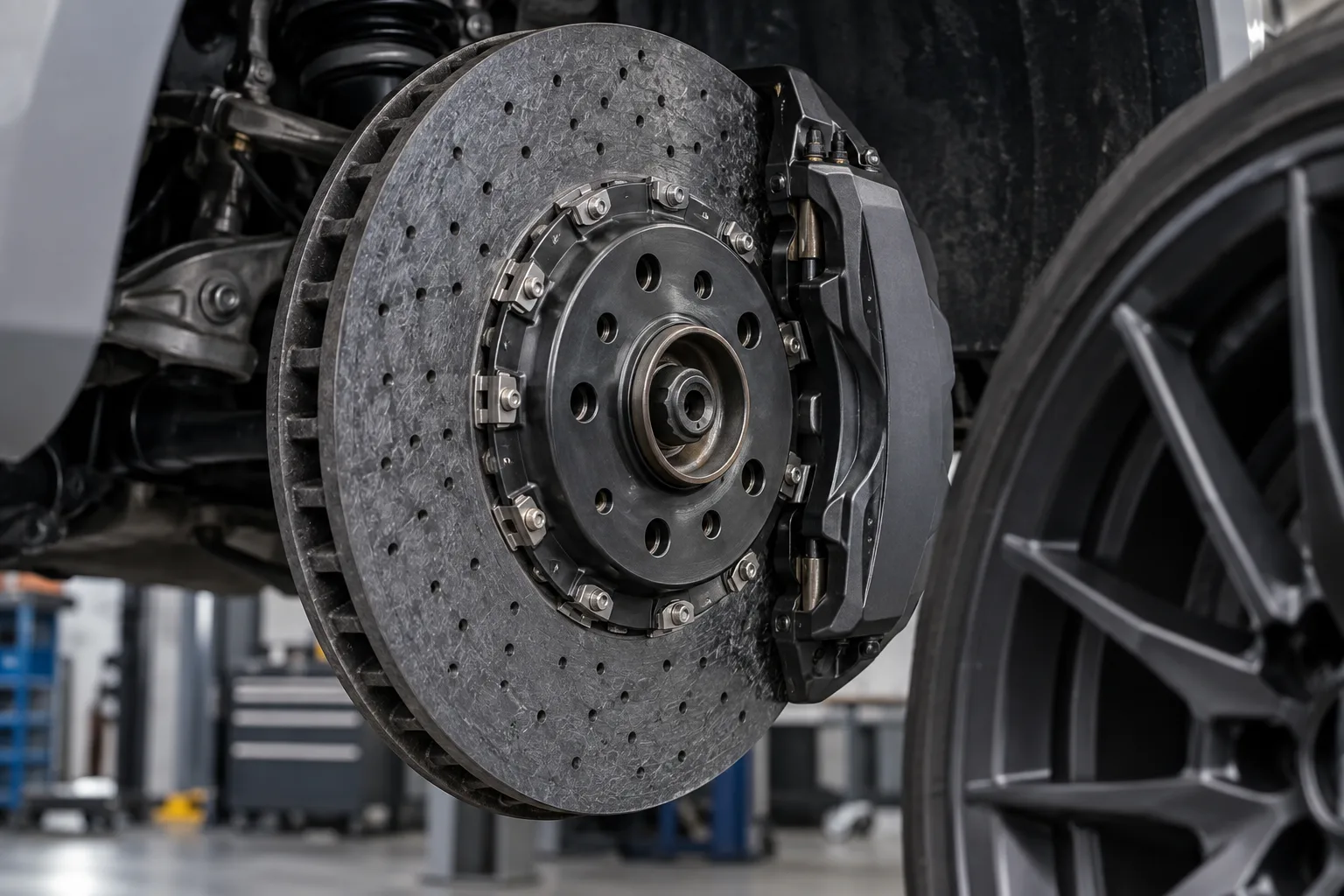
They fade less, weigh less and last far longer than steel — and cost a fortune to replace. What PCCB, CCB and the AMG equivalent actually mean when you read a spec sheet.
When a listing mentions PCCB, CCM or AMG composite brakes, it's describing one of the most misunderstood options on a performance car. Carbon ceramic discs are lighter, more fade-resistant and longer-lived than steel — and dramatically more expensive when they eventually need replacing.
The material is a carbon-fibre-reinforced silicon carbide composite. Manufacturing takes weeks per disc: the fibre preform is baked, infiltrated with silicon, and machined. That process is why a full set of rotors on a 911 can exceed $20,000 in parts alone.
The benefits are real. A carbon ceramic set saves 10 to 20 kg of unsprung mass, which improves ride, turn-in and tyre life. Fade resistance matters on track: steel brakes lose effectiveness when they exceed roughly 700°C, while carbon ceramics operate well beyond that. And while steel rotors typically last 50,000 to 80,000 km of mixed driving, carbon ceramics can exceed 150,000 km — assuming they're cared for.
The caveats matter equally. Cold performance is worse: for the first few hundred metres, carbon ceramics generate less bite than steel, which is why manufacturers fit aggressive pad compounds and brake pre-conditioning routines. They're brittle — a kerb strike that would merely score a steel disc can crack a ceramic one, and the replacement cost is per disc, not per axle. And measuring wear requires a depth gauge, not a glance.
When inspecting a used car with carbon ceramics, ask for a measured wear report on each disc. Most manufacturers specify a minimum thickness, and a set approaching it is a five-figure consumable. A car with fresh rotors and pads is worth a meaningful premium over one at 60% wear.
For road-biased cars, steel brakes are often the better value: cheaper to replace, better cold bite, and adequate for anything short of sustained track use. For track-focused cars — the GT3 RS, the 750S, the Huracán Tecnica — carbon ceramics are the correct specification and a selling point at resale.
Continue reading
Inside the 911 GT3 RS
The 992 GT3 RS generates more downforce than the previous generation's GT3 Cup car. We take apart what that actually changes on the road, and what you give up to get it.
9 min readEngineeringNaturally Aspirated Against the Turbo V8
The Huracán Tecnica and the AMG GT 63 make similar power in completely different ways. We compare throttle response, sound and where each one is faster on a real road.
10 min read