Naturally Aspirated Against the Turbo V8
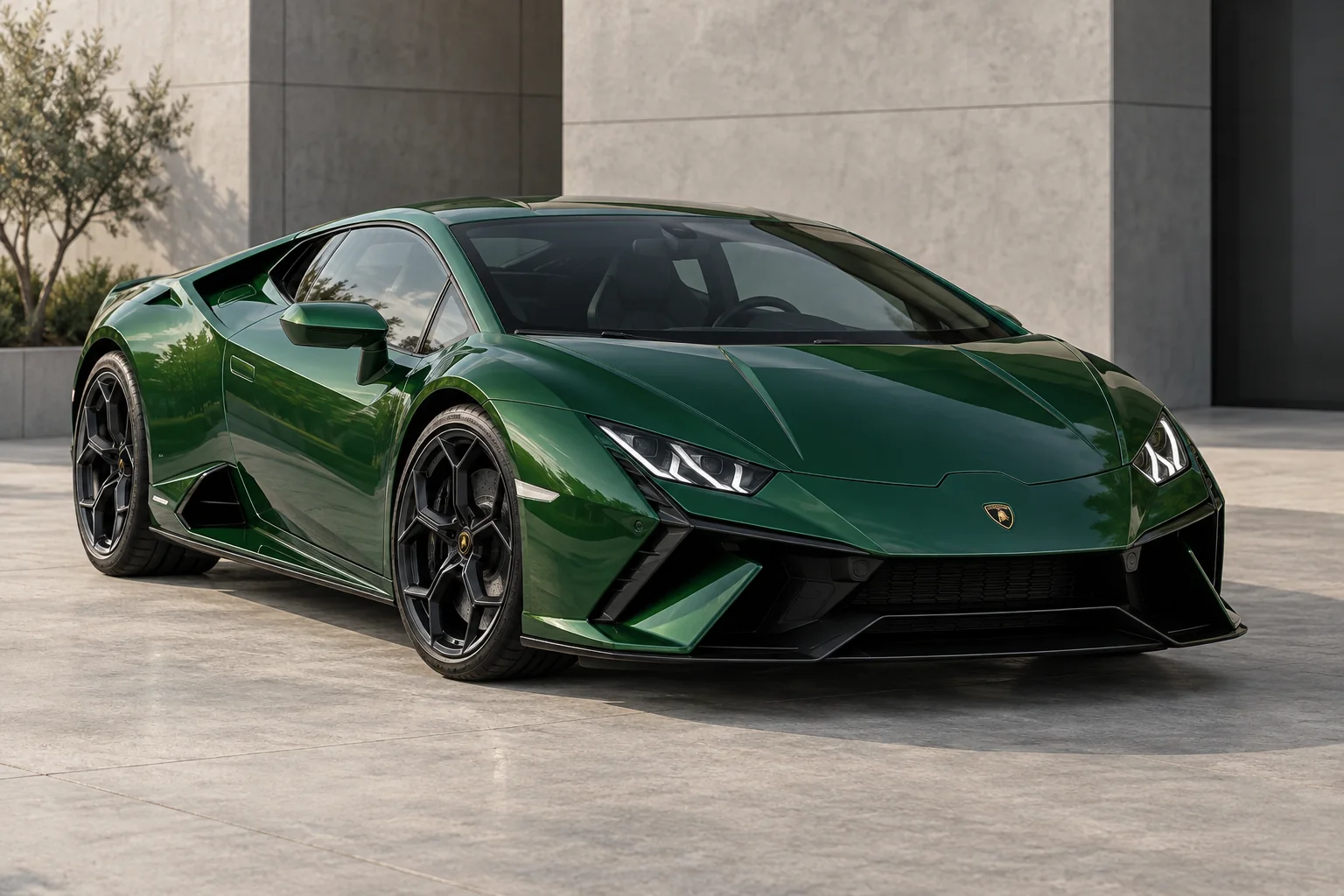
The Huracán Tecnica and the AMG GT 63 make similar power in completely different ways. We compare throttle response, sound and where each one is faster on a real road.
The Lamborghini Huracán Tecnica and the Mercedes-AMG GT 63 make broadly similar power from fundamentally different engines. The Tecnica's 5.2-litre V10 is naturally aspirated, revving to 8,500 rpm for 631 hp. The GT 63's 4.0-litre V8 uses two turbocompressors to reach 577 hp by 6,000. On paper they're comparable. Behind the wheel they're different instruments.
The turbocharged V8 delivers its torque early and holds it across a broad plateau: 590 lb-ft from roughly 2,500 rpm. In the real world — overtaking on a two-lane highway, pulling away from a light — that's the more useful engine. There's no gear hunt, no waiting for boost, just a shove available at any speed.
The V10 does the opposite. Its 417 lb-ft peaks high and the engine genuinely wants to be worked: below 4,000 rpm it feels almost polite, and the last 2,000 rpm is where the car comes alive. Modern naturally aspirated engines have largely eliminated throttle lag — the Tecnica's response to a partial-lift, mid-corner adjustment is instant in a way no turbo car matches.
Sound is the clearest difference and the least quantifiable. A high-revving NA V10 produces harmonics — the overtones above the fundamental note — that a turbocharged engine physically cannot, because the turbine absorbs exhaust energy that would otherwise become sound. It's why people describe the V10 as singing and the V8 as booming, and why the Tecnica's exhaust note is a large part of its value.
Where is each faster? Point-to-point, on any road with corners taken in second and third gear, the GT 63's torque advantage and all-wheel drive traction usually win. On a circuit with long straights and high-grip tyres, or on any road where you can use the full rev range, the Tecnica's power delivery and 100 kg weight deficit tell. Neither is universally quicker; they're quicker in different places.
There's a durability and value argument too. Naturally aspirated engines run lower cylinder pressures and simpler exhaust systems, and historically they've aged better — the final V10 Huracán already trades above its original list price in some configurations. Turbo V8s are robust but carry more thermal stress, and their long-term values follow the mass-production curve.
The honest answer is that these engines solve different problems. The turbo V8 is a better tool; the NA V10 is a better event. Which one you want depends on whether you're buying transport or an occasion — and on whether you've ever lifted off mid-corner in a car that rewarded you for it.
Continue reading
Inside the 911 GT3 RS
The 992 GT3 RS generates more downforce than the previous generation's GT3 Cup car. We take apart what that actually changes on the road, and what you give up to get it.
9 min readTechnicalUnderstanding Carbon Ceramic Brakes
They fade less, weigh less and last far longer than steel — and cost a fortune to replace. What PCCB, CCB and the AMG equivalent actually mean when you read a spec sheet.
8 min read