Storing a Performance Car Through a Canadian Winter
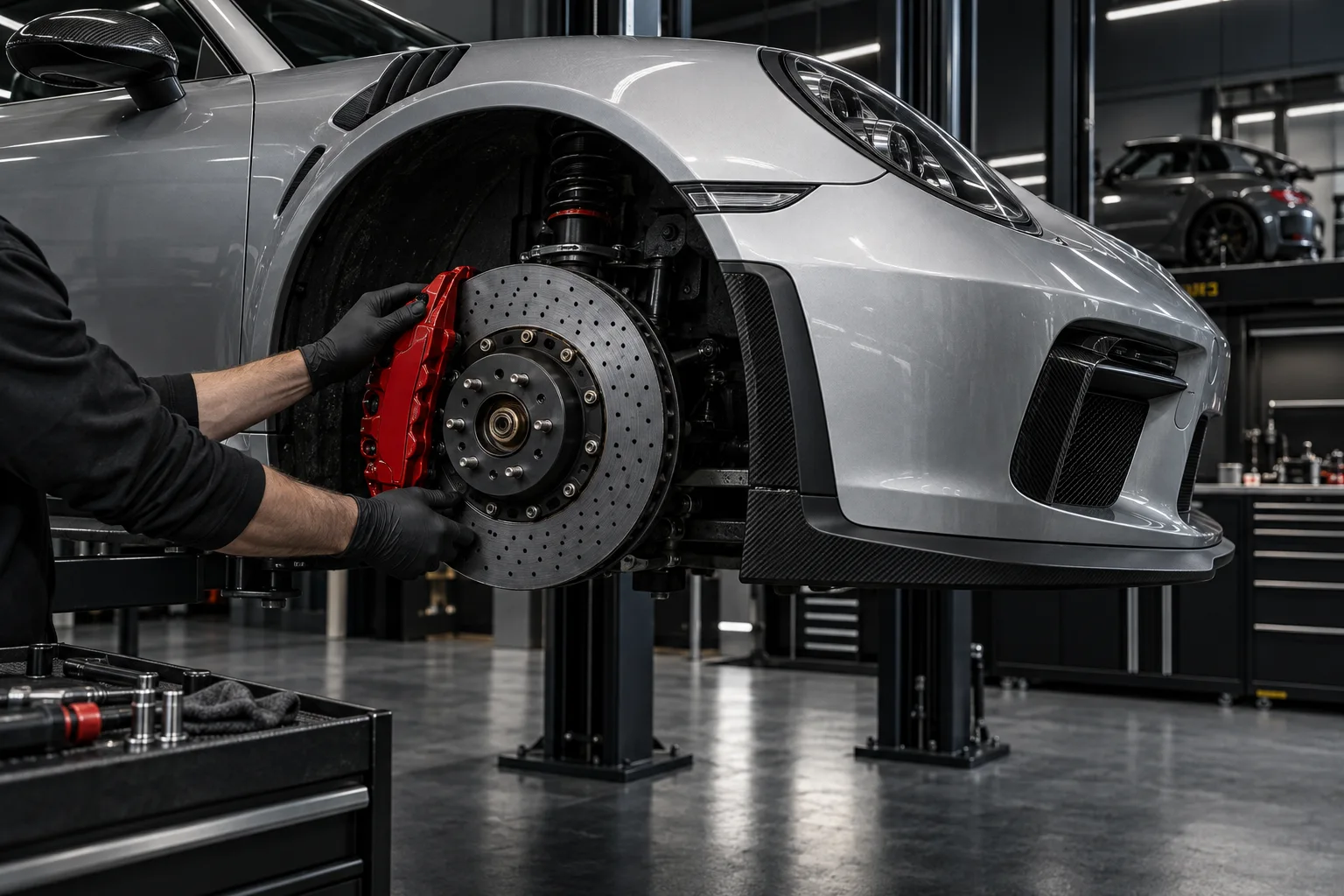
Salt, temperature swings and four months without a drive. How we prepare vehicles for long-term storage, and the five things owners most often get wrong.
A performance car parked from November to April faces two enemies: salt-laden air if it's stored poorly, and mechanical stagnation from sitting untouched. Neither is hard to manage, and almost every problem we see in spring comes from storage that was cheaper to arrange than it should have been.
Start with the environment. The goal is a dry, temperature-stable space. An unheated garage in Southern Ontario swings from -20°C to +10°C over a week, and each cycle condenses moisture inside the car — on brake rotors, inside the exhaust, on electrical contacts. A heated or at least insulated space does more for the vehicle than any additive you can buy.
Clean it properly first. A full decontamination wash, wheel-off if you can manage it, and a wax or sealant before storage. Road salt left on brake components, wheel barrels or the underbody does its damage in the first wet month. Interior leather should be cleaned and conditioned; a crumb or a spill left until spring is a permanent smell.
Fluids and fuel: fill the tank to roughly 90% to limit condensation headspace, and add a fuel stabiliser if the car will sit beyond three months. Change the oil before storage, not after — used oil holds acids and combustion by-products that attack bearing surfaces over months of inactivity. Top up the washer fluid with a winter-rated product if the car stays in an unheated space.
The battery is the most common failure. A quality maintenance charger — CTEK, NOCO, or equivalent — on a float setting is worth every dollar. Without it, expect a sulphated battery by March, particularly on cars with alarm and telemetry systems that draw a small current continuously. Lithium batteries need a charger with a lithium profile; the wrong charge curve can damage them.
Tyres develop flat spots when a car sits on one patch of rubber for months. Inflate to the upper end of the recommended pressure (roughly 10% over), move the car a metre every few weeks if possible, or put it on jack stands for long storage. Modern high-performance summer compounds are more susceptible than all-seasons.
And drive it occasionally if you can. Fifteen minutes of running every three weeks, brought fully to operating temperature, circulates fluids and dries condensation from the exhaust. A car that never starts between November and April is more likely to develop issues than one that runs briefly on a schedule.
We offer monitored indoor storage with battery conditioning, tyre preservation and a monthly condition report with photographs. Several clients store with us through the winter and collect in the spring, detailed and ready.
Continue reading
Inside the 911 GT3 RS
The 992 GT3 RS generates more downforce than the previous generation's GT3 Cup car. We take apart what that actually changes on the road, and what you give up to get it.
9 min readEditorialWhy the RS6 Avant Remains Unique
There is no direct rival to a 621-horsepower estate car. Three decades after the RS2, Audi still builds the only vehicle in its class — and Canadian buyers keep finding reasons for it.
7 min read